

Giving an AI agent access to a data platform is easy. Deciding what it may see, and for whom, is the work. An agent that can query everything can hand someone information they were never meant to have, in clear and confident sentences. The control that prevents it is not a prompt. It is classification, applied early and enforced in the data layer.
Most teams start by telling the agent what it must not do. That is a wish, not a control. The same question can be asked many ways, fields that are harmless alone can be combined into something that is not, and a person’s entitlement changes with their role. Enforcement has to sit where the data lives, so the agent cannot return what the data layer will not release.
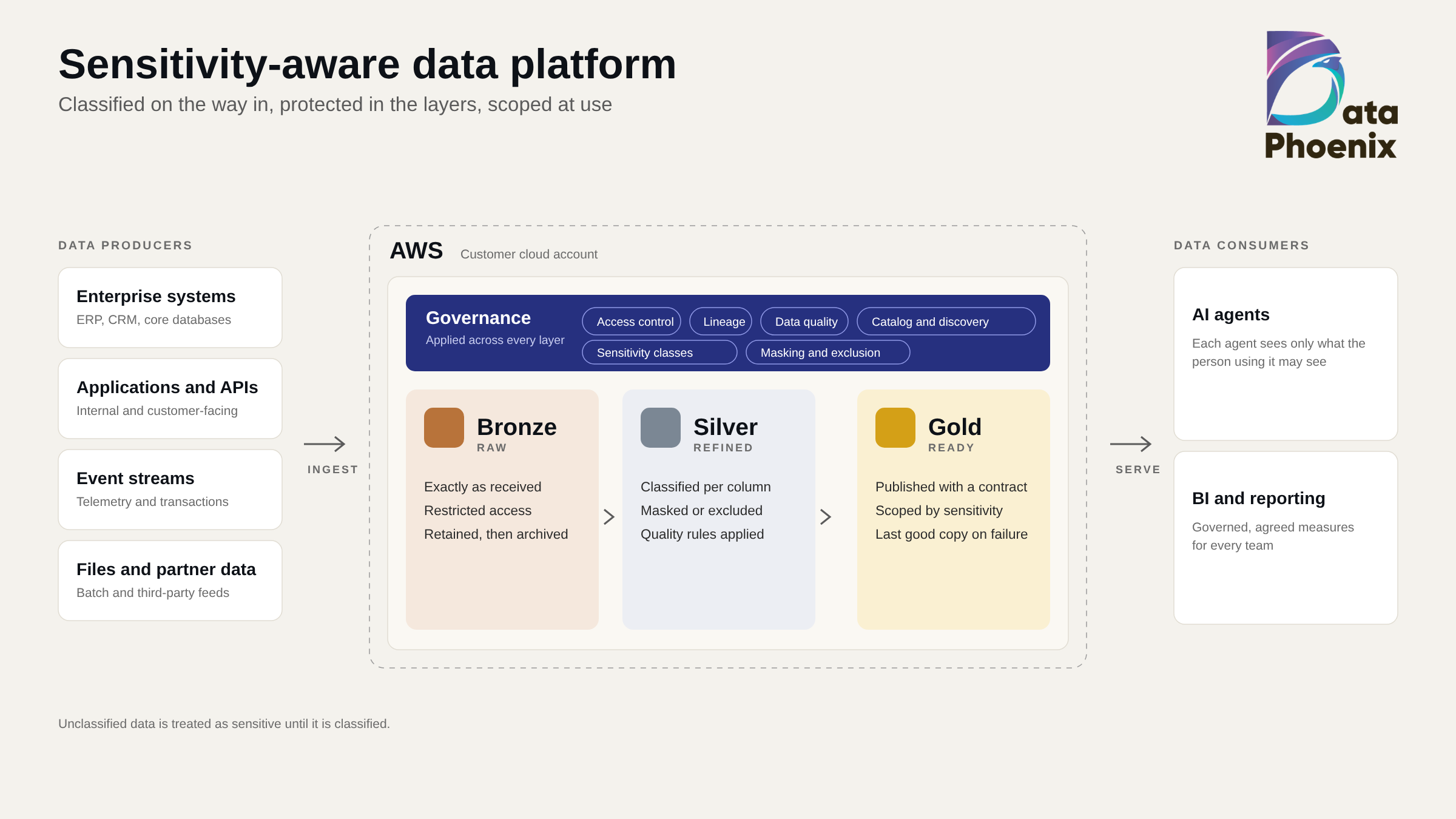
Every source field gets a sensitivity level when the source is onboarded, using tiered levels agreed with your security and compliance teams. A few rules make this workable. A dataset takes the highest level of any field it holds. A field that has not been classified yet is treated as sensitive until it is. Personal data is tracked as its own dimension, separate from severity, because a low-severity field can still be personal data under UK and EU GDPR.
In a medallion design, raw data in Bronze is kept exactly as supplied, with restricted access. Sensitive fields are dealt with on the way to Silver: exclude at source what the business should not hold at all, then mask, tokenise or pseudonymise the rest according to class. No source reaches Silver without a column-level classification, so the refined layer never holds a value its consumers have no right to read. Gold is published with a contract covering grain, schema, owner and refresh.
Each consuming system connects with its own identity, limited to the Gold datasets and classes it needs. The agent acts on behalf of a person, and what it can return is bounded by that person’s entitlement. Ask the same question as a first-line analyst and as an engineer on the resolving team, and the answers differ: the analyst learns that an incident happened, and the engineer also sees the affected host. One platform, one copy of the data, different views.
Lineage shows where each field came from, classification is recorded in the catalogue, and access is logged per identity. You can then answer who or what read which data, and why it was allowed.
The medallion design is where your obligations become concrete: how long raw data is retained and when it is archived, which fields are excluded rather than masked, how quality failures are quarantined before a consumer sees them, and what the platform serves when a source fails. These choices come from your regulators and your own policies, so they are decisions to make deliberately and not defaults to inherit. ISO/IEC 27001 information classification, the NIST Cybersecurity Framework and Privacy Framework, and GDPR give the scheme a recognised frame.
Start with the sources your first AI use case needs. Classify those, build the controls for them, and add sources as they are onboarded. DataPhoenix designs and delivers this on AWS as AI data access and sensitivity governance. From Raw to Ready covers delivering a new source, and data classification and PII covers the personal-data side.