

An AI agent is only as safe as the data it can reach. An agent that can query everything can hand someone information they were never meant to have. The control that prevents it is not a prompt. It is classification, applied early and enforced in the data layer, so the agent cannot return what the platform will not release.
DataPhoenix designs and delivers that data layer on AWS, so the agents your business adopts see what each person is entitled to see and no more.
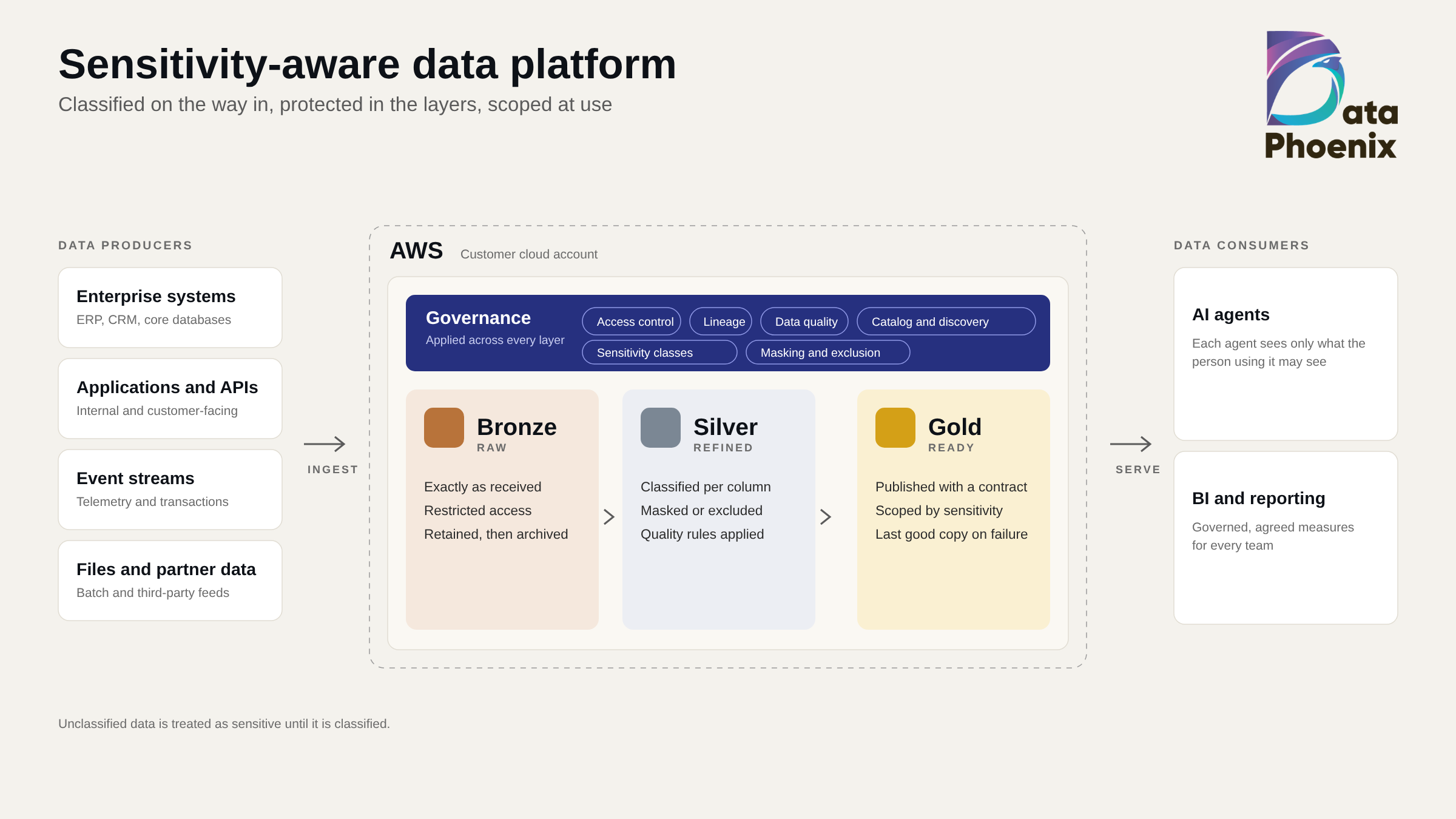
Every source field is given a sensitivity level when the source is onboarded, in tiered levels agreed with your security and compliance teams. A dataset takes the highest level of any field it holds. A field that has not been classified yet is treated as sensitive until it is. Personal data is tracked as its own dimension, separate from how severe disclosure would be.
Fields the business should not hold at all are excluded at source. The rest are masked, tokenised or pseudonymised according to their class, so the refined layer never contains a value its consumers have no right to read. No source reaches the refined layer without a column-level classification.
Each consuming system connects with its own identity, limited to the curated datasets and classes it needs. An agent acts on behalf of a person, and what it can return is bounded by that person’s entitlement. The same question can correctly give two people different answers: a first-line analyst learns that an incident happened, and an engineer on the resolving team also sees the affected host. One platform, one copy of the data, different views.
Your obligations become concrete in the design: how long raw data is retained and when it is archived, which fields are excluded rather than masked, how quality failures are quarantined before a consumer sees them, and what the platform serves when a source fails. Curated datasets are published with a contract covering grain, schema, owner and refresh.
Lineage shows where each field came from, classification is recorded in the catalogue, and access is logged per identity, so you can answer who or what read which data and why it was allowed.
The scheme is mapped to ISO/IEC 27001 information classification, the NIST Cybersecurity Framework and Privacy Framework, and UK and EU GDPR, so your classification is recognised outside the project.
Retrieval permissions are held to what the requesting person or workload may access. The data handed to an AI capability is minimised, retrieved content is treated as untrusted input because prompt injection is a threat, and AI queries are logged with an agreed retention. Where an AI capability handles sensitive or personal data, additional safeguards apply, and the approved models and endpoints are defined before use.
New sources are classified with an AI assistant working from metadata only: field names, a description of the source and synthetic examples, never records, credentials or personal data. The assistant asks structured questions and produces a draft classification with its reasoning and open questions, and a person reviews it before controls are applied.
A classification scheme and the column-level classification of your first sources, the platform controls for exclusion, masking and tokenisation, an identity and access model for consumers and agents, the medallion design with contracts and retention, and the lineage and audit setup. Everything is documented and owned by you.
Engagements start with the sources your first AI use case needs, and add sources as they are onboarded. DataPhoenix fits your delivery framework and works remotely with clients across the UK, the EU and Switzerland.
Want to learn more? The post classification before Silver explains the idea from first principles. Data classification and PII covers the personal-data side, private model enablement covers models that run on your own infrastructure, and data architecture and strategy sets the wider design.